
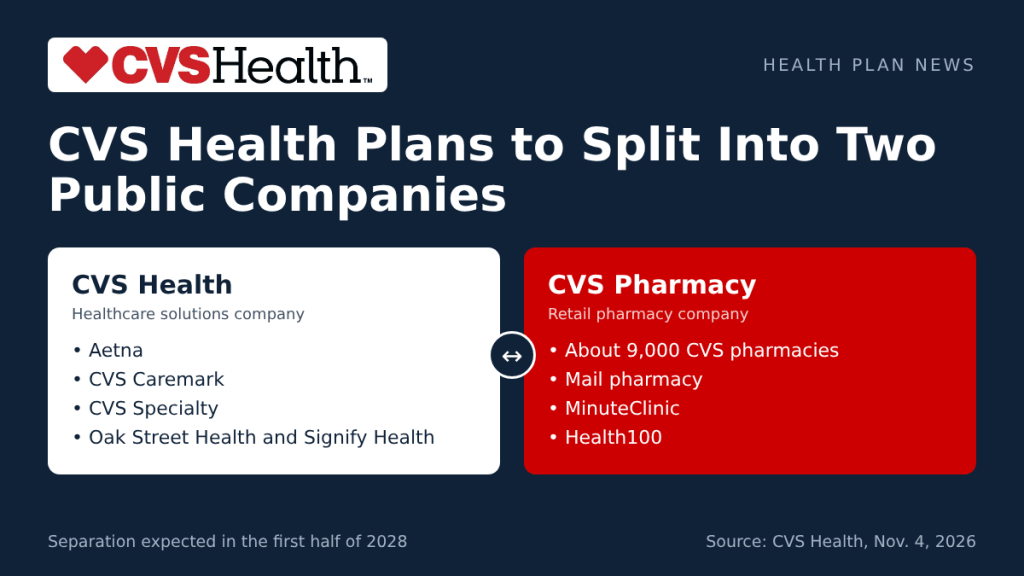
CVS Health plans to split into two publicly traded companies. Aetna, the CVS Caremark pharmacy benefit manager, CVS Specialty, Oak Street Health and Signify Health will stay together under the CVS Health name. The roughly 9,000 CVS stores, the mail pharmacy and MinuteClinic will become a separate company called CVS Pharmacy. The company announced the plan on November 4, 2026 and expects to finish it in the first half of 2028.
The most telling detail is what CVS chose to keep. The insurer and the PBM (pharmacy benefit manager, the company that runs drug benefits for health plans and employers) stay under one roof. The drugstores are the piece being let go. That unwinds part of the bet CVS made when it bought Aetna in 2018, and it lands as states try to bar PBMs from owning pharmacies.
For Aetna members and employers that use Caremark, nothing changes today. Coverage, ID cards and pharmacy networks stay as they are, and CVS says service will continue uninterrupted. Our read is that the real changes will show up in 2027 and 2028 contract renewals, so benefits buyers should start asking questions now rather than at signing.
What CVS Announced
The separation follows a strategic review by the CVS Health board. David Joyner, chairman and CEO, will lead the healthcare solutions company that keeps the CVS Health name. Prem Shah, now group president, will become CEO of CVS Pharmacy. Other executives and board members will be named later.
Shareholders will own stock in both companies. CVS intends the split to be tax-free to the company and its shareholders for federal income tax purposes. It still needs final board approval, an effective Form 10 registration statement with the Securities and Exchange Commission and confirmation of that tax treatment, according to the release CVS filed with the SEC.
“From a position of strength, and a focus on the long term, we plan to create two focused companies to improve consumer engagement, affordability, and care coordination,” Joyner said in the announcement.
CVS paired the news with third quarter results. It reported profit of $2.2 billion on $108.4 billion in revenue, according to trade press coverage of the earnings call, and raised its full-year 2026 outlook. Investors were not persuaded. The stock fell about 13% in afternoon trading, a loss of nearly $15 billion in market value, Reuters reported.
Why This Matters for Health Plan Members and Employers
CVS Health covers an estimated 37 million people through its health insurance products, and Caremark manages benefits for about 87 million plan members, according to the company. That puts Aetna among the largest carriers on our list of U.S. health insurance companies.
Your pharmacy benefit manager and your pharmacy will be two different companies
Under the plan, CVS Caremark stays with Aetna in the new CVS Health. The CVS stores and the mail pharmacy move to CVS Pharmacy. Once the split closes, a Caremark member who fills a 90-day prescription at a CVS store or by mail will be dealing with a company that no longer shares an owner with the PBM.
Joyner told analysts the retail pharmacy has always operated behind a firewall. He said the overlaps worth keeping will move into commercial agreements between the two companies, according to the same coverage. Those agreements will decide whether convenient programs, such as filling a 90-day supply at a store at the mail-order price, survive in their current form.
CVS Specialty, which handles high-cost drugs for conditions such as cancer and multiple sclerosis, stays with Caremark. Members on specialty drugs should see the least disruption.
State laws on PBM-owned pharmacies are part of the backdrop
Arkansas passed a 2025 law that bars PBM owners from holding pharmacy permits in the state. A federal judge blocked it in July 2025 after CVS and others sued. CVS is also challenging a similar Tennessee law, and a bipartisan federal bill would require the same separation nationwide.
Joyner said regulation did not drive the decision. Analysts saw it differently. Leerink’s Michael Cherny said the move could help CVS avoid “relentless state legislative scrutiny,” and Morningstar’s Julie Utterback noted that CVS “has the most exposure to vertical integration in the industry.”
What the Press Release Leaves Out
The release lists benefits for shareholders: focus, agility, an investment-grade rating and a dividend for each company. It says little about prices.
Pulling the stores out does not change the arrangement that has drawn the most criticism. Caremark keeps setting formularies, negotiating manufacturer rebates and deciding which pharmacies get paid what, and it still answers to the same parent as Aetna. The split leaves that model untouched.
What could shift is negotiating leverage. CVS Pharmacy says it will pursue partnerships with payers, PBMs and manufacturers across the system. A stand-alone chain of about 9,000 stores has every reason to push Caremark, Express Scripts and Optum Rx for better reimbursement, and to court rival plans that had little reason to send members into a competitor’s stores. Retail pharmacy has thinned out: Rite Aid closed its remaining stores in 2025, and Walgreens went private. That leaves CVS Pharmacy with more leverage at the bargaining table, not less.
Barclays analyst Andrew Mok put the investor complaint plainly: there are not yet enough financial details. Members and employers have the same problem. The commercial agreements between the two companies will matter more than anything in this release, and none of them have been published.
What To Do Next
- Keep using your Aetna and Caremark benefits as you do now. Nothing changes until the separation closes, which CVS expects in the first half of 2028.
- Ask your broker or Caremark account team how retail and mail pharmacy terms will carry over after the split, if your company’s PBM contract renews in 2027 or later.
- Check which pharmacies your plan prefers for 90-day fills, and confirm the price at each before you switch.
- Watch for the Form 10 filing. It will lay out the agreements between the two companies in more detail than any press release.
For ways to lower what you pay at the counter in the meantime, see our guide on how to cut medication costs without cutting your care. Medicare members with Aetna or SilverScript Part D coverage keep the annual out-of-pocket cap described in our report on Medicare’s Part D cap.
We will follow the separation as CVS files more detail, including the agreements between the two companies, on our Health Insurance Companies and Prescription Drugs and Pharmacy hubs.