
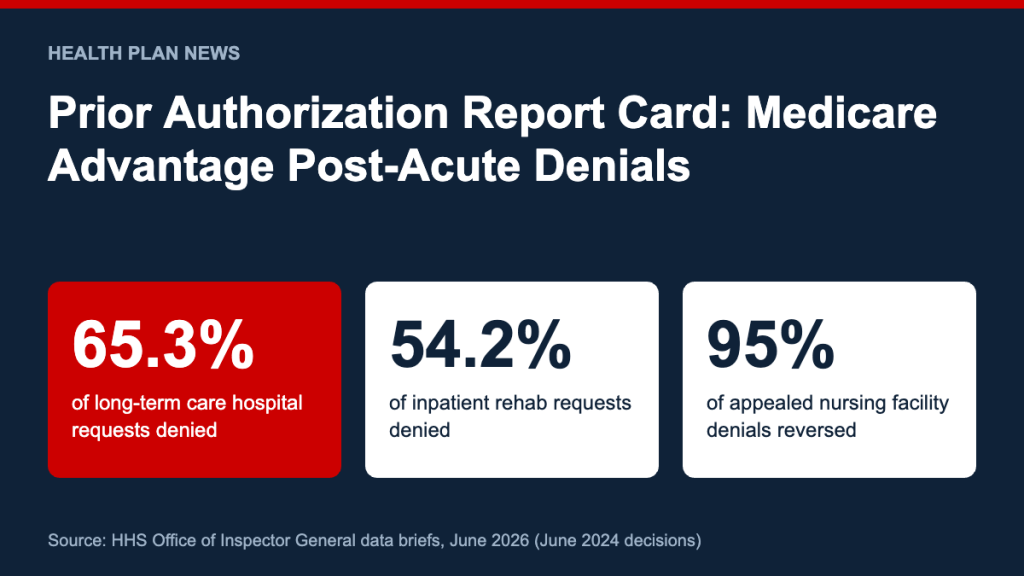
Medicare Advantage plans denied 65.3% of requests for long-term care hospital stays in June 2024, the HHS Office of Inspector General (OIG) found in a data brief released this year. Aetna, Humana and UnitedHealth Group each denied more than 70% of those requests.
That figure anchors a new Health Plan News reference page, the Prior Authorization Report Card, which brings together federal audits, state regulator reports, a national physician survey and the first insurer-published prior authorization metrics. Prior authorization is the advance approval a plan requires before it will pay for care.
The pattern across every source is the same. Denials are concentrated in expensive, time-sensitive care, few patients appeal, and appeals that are filed often succeed. If your plan denies a request, ask your doctor to appeal.
What the Inspector General Found
The OIG reviewed decisions by 19 Medicare Advantage organizations in June 2024. Long-term care hospitals treat patients who need weeks of hospital-level care, such as people coming off ventilators. Plans denied 2,108 of 3,230 requests for those stays. They denied 54.2% of requests for inpatient rehabilitation, where patients go after a stroke or major surgery.
Skilled nursing denials were lower overall, at 12%. But nursing home residents were denied 40% of the time, compared with 11% for other enrollees, according to a companion OIG brief. Only 18% of skilled nursing denials were appealed. Plans reversed 95% of them.
naviHealth, a UnitedHealth Group subsidiary that reviews post-acute care requests for several plans, handled half of the skilled nursing requests in the sample. Ninety-seven percent of its appealed denials were overturned.
What Physicians Say
The American Medical Association surveyed 1,000 physicians in December 2025. The AMA is a physician advocacy group that supports reform, so its findings reflect one side of the debate. Still, the numbers are hard to wave away.
- 26% of physicians said prior authorization had led to a serious adverse event for a patient.
- Physicians and their staff spend 13 hours a week on prior authorizations.
- 60% worry that insurers’ use of artificial intelligence (AI) will push denial rates higher.
The full results are in the AMA’s survey report.
The States Start Counting
Massachusetts and Hawaii are among the first states to publish prior authorization data from insurers. Massachusetts carriers received 1.58 million requests in 2024, up 13.3% in a year, and approved 86.2%. Approval for lab and pathology services fell to 64.6%. In Hawaii, insurers denied 11.6% of requests in 2025, with Medicaid plans denying 14.2%.
Insurers now have to publish their own numbers too. A federal rule from the Centers for Medicare & Medicaid Services (CMS) requires Medicare Advantage, Medicaid and HealthCare.gov plans to post prior authorization metrics each year, beginning March 31, 2026. The same rule sets decision deadlines of 72 hours for urgent requests and seven days for standard ones.
Why This Matters for Medicare Enrollees
The Medicare Annual Enrollment Period runs through December 7. Original Medicare rarely requires prior authorization; most Medicare Advantage plans use it for hospital stays, rehabilitation and skilled nursing. That is a real trade-off against Medicare Advantage’s extra benefits and lower premiums, and it lands hardest after a hospital stay, when patients and families have the least time to fight a denial.
Before you enroll, check the plan’s prior authorization metrics on its website and ask how it handles post-acute care. Our Medicare hub tracks plan changes for 2027.
What To Do Next
- Ask your doctor to request a peer-to-peer review with the plan’s medical reviewer.
- Get the denial in writing, including the clinical criteria the plan used.
- File an appeal, and request an expedited appeal if waiting could harm your health.
- Call 1-800-MEDICARE or your state insurance department for free help.
Denials of claims after care is delivered are a separate problem. Our new claim denial rankings for 157 HealthCare.gov insurers cover that side, and our Healthcare Policy and Law hub follows state and federal reform bills.