
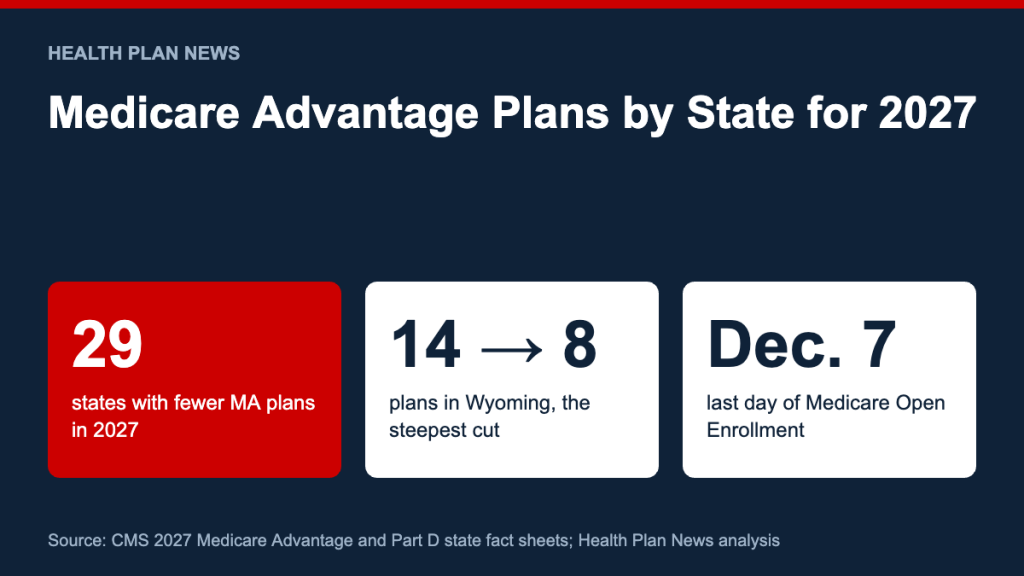
People with Medicare in 29 states will have fewer Medicare Advantage plans to choose from in 2027 than they had this year, according to state fact sheets from the Centers for Medicare & Medicaid Services (CMS). Wyoming drops from 14 plans to 8, Montana from 32 to 23 and Maryland from 63 to 47.
The pullback is uneven. Twenty-one states gain plans, led by Tennessee, Missouri and Alabama. Health Plan News compiled every state’s numbers, along with premiums and Part D options, on a new reference page: Medicare Advantage Plans by State for 2027.
If you are in a Medicare Advantage plan, open your Annual Notice of Change now. Medicare Open Enrollment ends December 7, and a plan that disappears from your county will not follow you into January.
Where Plans Are Shrinking and Growing
CMS publishes a fact sheet for each state every fall. Comparing 2027 with 2026 shows the sharpest percentage cuts in Wyoming, Montana, Maryland, the District of Columbia and Minnesota, where the count falls from 68 to 53.
On the other side, Tennessee adds 23 plans, from 132 to 155. Missouri goes from 157 to 174, Alabama from 98 to 113, Arizona from 133 to 148 and Indiana from 127 to 140.
Florida still has the most choices by far, with 560 plans, followed by Texas, California, Pennsylvania and New York. Alaska has no Medicare Advantage plans listed at all.
More plans is not the same as better plans, so the count alone should not drive a decision.
Average monthly Medicare Advantage premiums rise in 19 states. In Wyoming, the average climbs from $45.91 to $69.23. In most states, though, nearly everyone with Medicare can still find a plan with a $0 monthly premium.
Why Insurers Are Pulling Back
Medicare Advantage insurers have reported higher medical costs for two years running, and several have cut unprofitable counties, PPO plans and extra benefits. UnitedHealthcare, the largest carrier, told investors it expected to lose more than a million Medicare Advantage members in 2026 as it exited markets.
Federal payment policy is part of the debate. The Medicare Payment Advisory Commission (MedPAC), which advises Congress, estimates Medicare will spend 14% more on Medicare Advantage enrollees in 2026 than it would in traditional Medicare, about $76 billion, in its March 2026 report. Insurers dispute that method.
Quality ratings moved the other way. About 71% of Medicare Advantage drug plan enrollees are in contracts rated 4 stars or higher for 2027, according to the CMS Star Ratings fact sheet.
What It Means for Part D
The 2027 Part D base beneficiary premium is $41.33, up 6% from $38.99, the largest increase the law allows. Most states will have eight to 11 stand-alone Part D plans, and the lowest premium is $5.30 a month in most of them. Part D enrollees also keep the annual out-of-pocket cap on covered drugs.
What To Do Before December 7
- Read your Annual Notice of Change for 2027 premiums, networks and drug coverage.
- If your plan is leaving your area, use the special enrollment period to choose new coverage, and ask about your right to buy a Medigap policy.
- Compare plans on Medicare Plan Finder using your actual prescriptions and pharmacies.
- Check each plan’s star rating and prior authorization rules before you switch.
- Call your State Health Insurance Assistance Program (SHIP) for free, unbiased help.
Prior authorization deserves a close look, because Medicare Advantage plans deny post-acute care at high rates. Our Prior Authorization Report Card has the federal audit numbers, and our earlier report explains how Medicare Advantage plans denied 65% of long-term hospital requests. Follow our Medicare hub for carrier announcements through the end of Open Enrollment.