
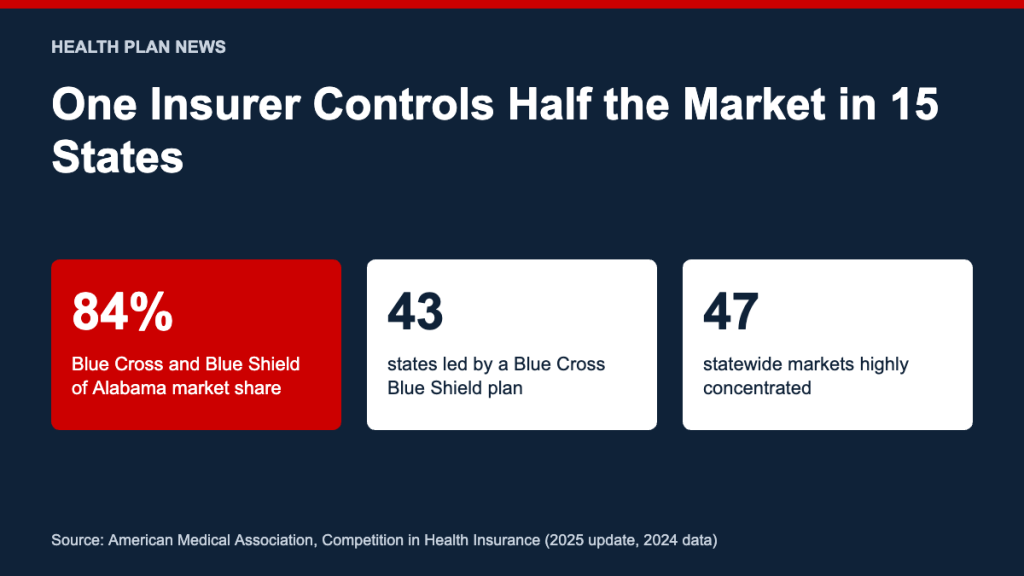
A single health insurer controls at least half of the commercial health insurance market in 15 states, and a Blue Cross Blue Shield company is the largest insurer in 43 of 50 states and the District of Columbia, according to the latest American Medical Association (AMA) study of insurer competition. In Alabama, Blue Cross and Blue Shield of Alabama holds 84% of the market.
Concentration matters because it shapes what employers and families pay and how much leverage doctors and hospitals have at the bargaining table. Health Plan News compiled every state’s figures for commercial coverage, the ACA Marketplace and Medicare Advantage on a new reference page: Health Insurance Market Share by State.
If you buy your own coverage, look past the biggest name in your state. Smaller insurers often price below the market leader, usually in exchange for a narrower network.
The Most and Least Concentrated States
After Alabama, the most concentrated commercial markets are Kentucky, where Elevance Health’s Anthem plans hold 76%, Hawaii (HMSA, 66%), Michigan (Blue Cross Blue Shield of Michigan, 65%) and Illinois (Blue Cross and Blue Shield of Illinois, 62%).
Oregon, New York, Washington and Wisconsin are the most competitive, with no insurer above 30% of the market. They are the exception.
Forty-seven of the 51 statewide markets exceed the threshold that federal merger guidelines use to define a highly concentrated market, measured by the Herfindahl-Hirschman Index (HHI), a score that rises as fewer companies control more of the market. At the metro level, the AMA found 97% of markets were highly concentrated.
Medicare Advantage and the Marketplace
The picture shifts outside employer coverage. UnitedHealth Group is the largest Medicare Advantage insurer in 30 states, and Humana leads in nine. UnitedHealthcare holds 86% of Medicare Advantage enrollment in Wyoming.
On the ACA exchanges, Centene’s Ambetter plans led in 12 states in mid-2024, and one insurer had at least half of exchange enrollment in 21 states. Those shares are already shifting as insurers leave for 2027; our report on Marketplace insurer exits tracks the changes.
Why the Blues Dominate
Each Blue Cross Blue Shield plan is licensed for its own territory, and many have been the largest local insurer for generations. They hold the broadest provider networks, which makes them the default choice for employers that need coverage in every county.
That advantage compounds.
The AMA, a physician group with an interest in stronger insurer competition, cites research linking concentration to higher premiums and lower payments to physicians. Insurers counter that scale lets them negotiate lower hospital prices. Both effects can be true in the same market.
What To Do Next
- Compare at least three insurers when you shop the Marketplace.
- Check networks before price, since a dominant insurer often has the only broad network.
- Employers can ask brokers about self-funded and level-funded plans.
- Review each insurer’s record in our claim denial rankings.
State-by-state insurer lists are in our guides for Texas, Illinois, Michigan and five other states. Follow our Health Insurance Companies hub for more.