
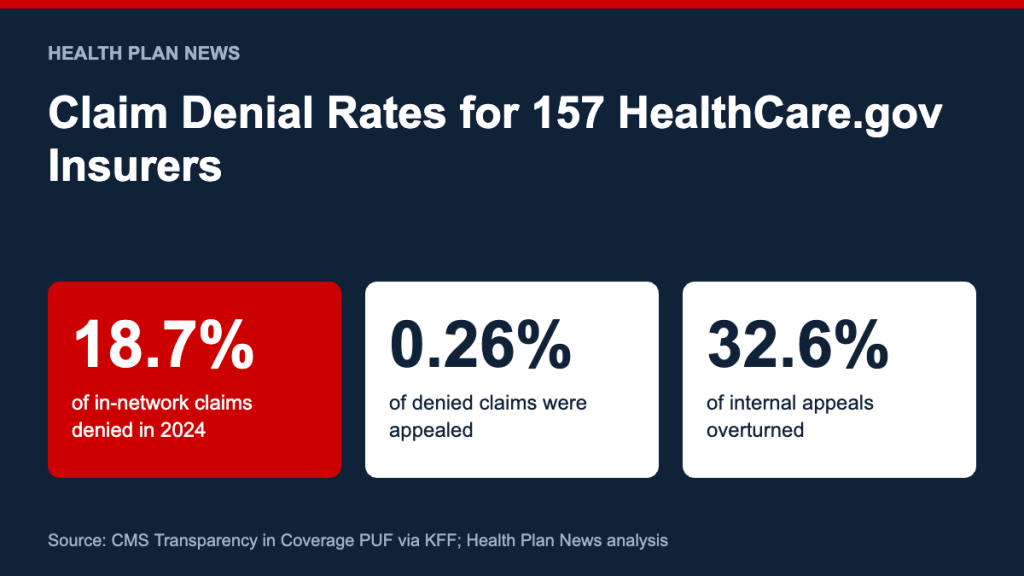
Insurers selling Affordable Care Act (ACA) plans on HealthCare.gov denied 18.7% of the in-network claims they received in 2024, according to federal data analyzed by Health Plan News. That is 84.5 million denied claims out of 451 million, and the rate ran from 2.7% at the best insurer to 35.7% at the worst.
The spread is the story. Two plans with the same premium and the same metal level can carry very different odds that a claim gets paid. We have published the full results, insurer by insurer, on a new reference page: Health Insurance Claim Denial Rates by Insurer.
If you are shopping for a 2027 plan, look up your insurer before you pick. And if a claim was denied this year, appeal it. Our read of the numbers is simple: denials are common, appeals are rare, and appeals often win.
What the Federal Data Shows
The figures come from the Transparency in Coverage public use file that the Centers for Medicare & Medicaid Services (CMS) publishes each year for marketplace insurers. KFF cleaned the 2024 data and released it as a working file covering 157 insurers in the 30 states that use HealthCare.gov. Health Plan News used that file to rank insurers, parent companies and states.
- In-network denial rate: 18.7%. Counting out-of-network claims, insurers denied 20.4% of all claims.
- Consumers filed internal appeals equal to just 0.26% of denied claims.
- Insurers reversed 32.6% of those internal appeals.
- Independent external reviewers reversed 32.8% of the cases that reached them.
Which Insurers Deny the Most Claims
Among parent companies with at least 3 million in-network claims, Corewell Health’s Priority Health had the lowest denial rate at 7.9%. Elevance Health, which runs Anthem plans, was close behind at 8.3%.
Oscar Health had the highest rate among large parent companies, at 24.9%. GuideWell’s Florida Blue and Molina Healthcare each denied 22.4% of in-network claims. Centene, the largest marketplace insurer through its Ambetter plans, came in at 18.5%, close to the national rate. UnitedHealthcare was at 19.2% and Cigna at 21.3%.
The gap between the best and worst large insurers is more than three to one.
The single highest rate belonged to Imperial Insurance Companies in Texas, at 35.7%. The lowest was Avera Health Plans in South Dakota, at 2.7%. Profiles of the larger carriers are on our list of U.S. health insurance companies.
Where you live matters too
South Dakota had the lowest combined in-network denial rate at 6.5%, followed by North Dakota and New Hampshire. Hawaii had the highest at 27.0%, then Alaska and Florida. Texas, the largest HealthCare.gov market with 120 million in-network claims, landed near the middle at 18.5%.
States that run their own marketplaces are missing from the federal file. Some publish their own numbers. Pennsylvania’s insurance department reported a 14.8% denial rate for its individual-market ACA plans in 2024, up from 13.8% the year before.
What a Denial Rate Can and Cannot Tell You
A high denial rate is a warning sign, not a verdict. The federal file does not say why each claim was denied. Some denials are billing errors the provider fixes and resubmits. Others follow from plan design, such as an HMO that does not cover out-of-network care or a service the plan excludes. An insurer with sicker members or more complex claims may also deny more often.
What the data does show is that consumers almost never push back. Fewer than three in every thousand denied claims led to an appeal. That is the gap worth closing, because a third of internal appeals and a third of external reviews ended with the denial reversed.
What To Do if Your Claim Is Denied
- Read the denial letter and your explanation of benefits (EOB). Both must state the reason and how to appeal.
- Call the provider’s billing office first. Coding mistakes are common and easy to correct.
- File an internal appeal with your insurer within 180 days of the denial notice.
- Request an external review if the insurer upholds the denial. The independent reviewer’s decision is binding on the insurer.
- Ask your state insurance department or consumer assistance program for free help.
For more on how plans decide what to pay, see our earlier report on a company that steps in to pay for care after a claim denial, and follow our Health Insurance Companies hub for updates when CMS releases the next year of data.