
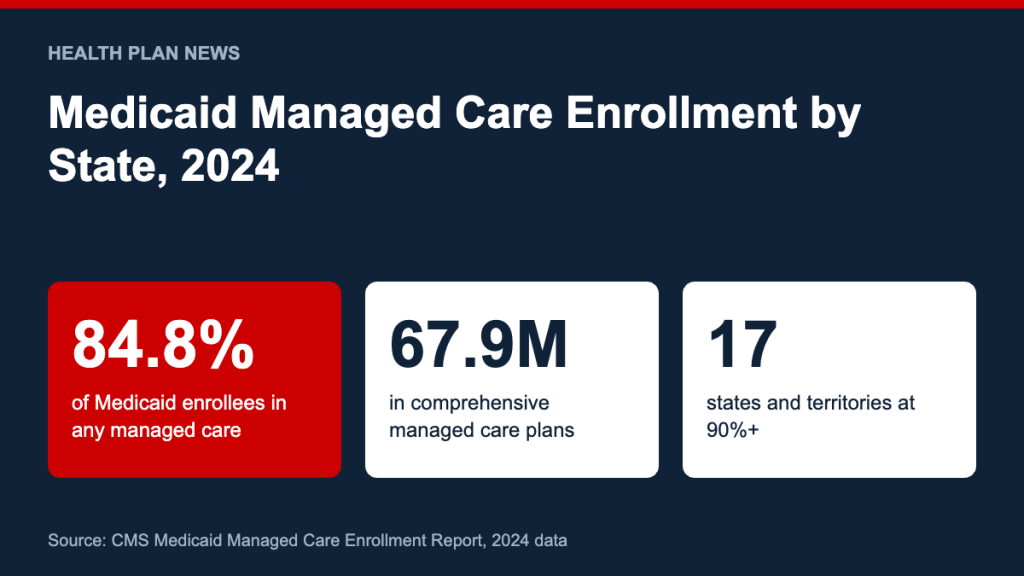
Nearly 68 million Medicaid enrollees, 78.2% of the program, got their care through a comprehensive managed care plan in 2024, according to federal enrollment data from the Centers for Medicare & Medicaid Services (CMS). Counting dental, behavioral health and other limited plans, 84.8% of Medicaid’s 86.9 million enrollees were in some form of managed care.
That makes Medicaid one of the largest lines of business for private insurers, and the state you live in decides how much of it they run. Health Plan News compiled the figures for every state and territory on a new reference page: Medicaid Managed Care Enrollment by State.
If you are on Medicaid, the plan named on your card, not the state, likely decides which doctors you can see and which treatments need approval. Read the mail from your state Medicaid agency, because plan changes arrive there first.
What the Federal Data Shows
Seventeen states and territories enrolled at least 90% of members in comprehensive managed care. Hawaii, Vermont and Puerto Rico reported 100%, followed closely by Nebraska and Michigan.
A handful of states went the other way. Comprehensive plans covered less than a quarter of enrollees in North Dakota, Idaho, Arkansas, Colorado and Alabama. Maine, Montana, South Dakota and Wyoming reported no comprehensive managed care program. Alaska and Connecticut reported no managed care enrollment of any kind.
The shift over the past eight years has been dramatic. Michigan’s comprehensive share nearly doubled, from 49.9% in 2016 to 98.0% in 2024. Nebraska climbed from 78.4% to 99.8%, and Vermont went from 62.1% to 100%.
In most states, Medicaid is now government-funded rather than government-run.
That distinction matters when something goes wrong. A complaint about a denied MRI or a missing specialist usually starts with the plan, and the state agency steps in only after the plan’s own appeal process runs its course.
Who Runs These Plans
A comprehensive managed care organization (MCO) receives a fixed monthly payment for each member and is responsible for most of that person’s medical care, from doctor visits to hospital stays and prescriptions. States award these contracts through competitive bids, often for five years at a time.
A small group of publicly traded companies holds a large share of the contracts. Centene, Elevance Health, UnitedHealthcare Community Plan, Molina Healthcare and CVS Health’s Aetna Better Health all operate Medicaid plans in many states, alongside nonprofit carriers such as CareSource and AmeriHealth Caritas. Our List of Health Insurance Companies includes the major Medicaid carriers.
Those contracts are worth fighting over.
Losing bidders often protest state awards, and a single rebid can move hundreds of thousands of members to a new plan.
Enrollment Is Shrinking Again
The 2024 figures capture a program in decline. Total Medicaid and CHIP enrollment fell to 72.9 million in July 2026, and Medicaid alone dropped 4.6 million, or 7%, from July 2025, according to the CMS enrollment snapshot. States continue to remove people at renewal, often for paperwork reasons.
Fewer members means less revenue for the plans, and the people who remain tend to be sicker and costlier to cover. Medicaid insurers have told investors for two years that their costs are rising faster than state payments. Expect more pressure on networks and more prior authorization, not less.
What To Do If You Are on Medicaid
- Respond to every renewal notice from your state, including when nothing about your income or household has changed.
- Check whether your doctors are in your plan’s network before you need care.
- If your state assigns you a new plan, use the choice period, often 90 days, to pick a different one.
- Ask your plan for its prior authorization rules, which it now has to publish.
- Call your state Medicaid agency or ombudsman if a plan denies care or a renewal is wrongly closed.
Plan denials hit Medicaid members too. Our Prior Authorization Report Card includes Hawaii’s 2025 data, where Medicaid plans denied 14.2% of requests, the highest of any market. For state contract awards and enrollment updates, follow our Medicaid and CHIP hub.