
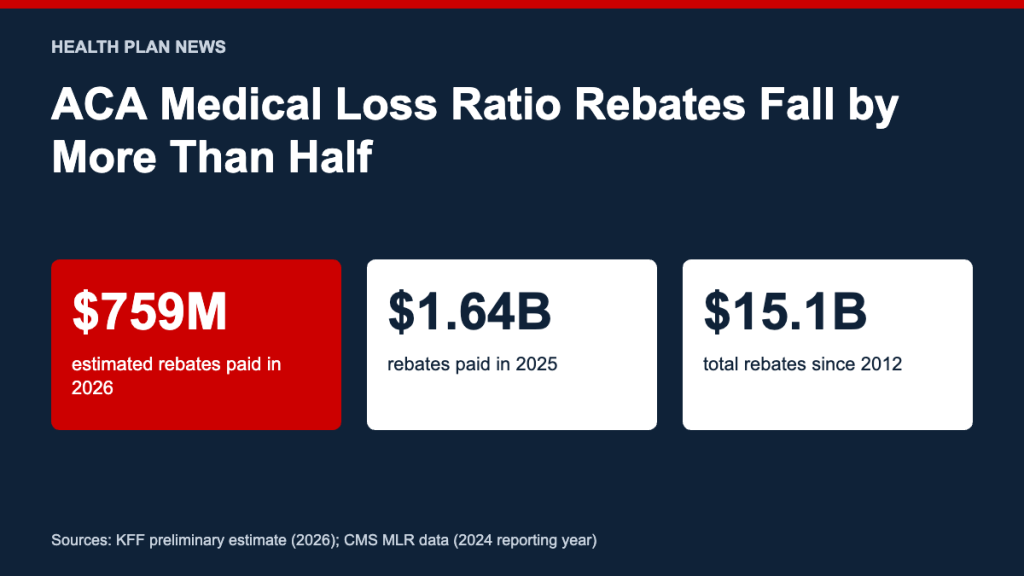
Health insurers are returning about $759 million to customers in 2026 under the Affordable Care Act’s medical loss ratio rule, less than half the $1.64 billion they paid in 2025, according to a preliminary KFF estimate based on insurer filings.
The drop says more about medical costs than about insurer behavior. Rebates are owed only when an insurer spends less than 80% of premiums on care in the individual and small group markets, or 85% in large group. Claims have run high for two years, so fewer insurers fell below the line. Health Plan News explains how the rule works in a new guide: Medical Loss Ratio Rebates Explained.
If you buy your own coverage, watch the mail. Individual market rebates go straight to the policyholder, as a check, a premium credit or a refund to the card you pay with.
How 2025 Rebates Broke Down
The final federal numbers for last year show where the money went. Of the $1.64 billion, $1.18 billion went to 5.06 million people with individual plans, an average of $233 each, according to Centers for Medicare & Medicaid Services (CMS) data. Small group plans returned $274 million and large group plans $186 million.
Rebates have totaled about $15.1 billion since 2012, according to KFF. The record came in 2020, at $2.5 billion, when the pandemic put elective care on hold.
Why the Number Fell
The calculation uses a three-year average, so 2026 rebates reflect 2023 through 2025. Those were years of rising hospital use, costly specialty drugs and surging demand for GLP-1 weight loss medications.
Smaller rebates and rising claims usually mean the same thing for next year: higher premium filings.
There is also a criticism worth knowing. Insurers owned by large health care companies can count payments to their own clinics and pharmacies as medical spending, which helps them meet the 80% or 85% threshold. The rule does not separate those payments from care delivered by unrelated providers.
What To Do Next
- Look for a rebate notice from your insurer; payments were due by September 30.
- If you have employer coverage, ask HR how any rebate was shared with workers.
- Search the CMS list of insurers owing refunds by state and market.
- Compare insurers on other measures too, such as our claim denial rankings.
Self-funded employer plans are outside the rule; our guide to self-funded and level-funded plans explains the difference. Follow our Health Insurance Companies hub for premium filings for 2027.