
Health Care Service Corporation (HCSC), the parent of Blue Cross and Blue Shield plans in Illinois, Montana, New Mexico, Oklahoma and Texas, launched the HCSC Community Impact Foundation on November 19, 2026. The company calls it a national foundation that will make national and local grants. The announcement left out the figure nonprofits care about most: how much money the foundation will give away.
The move matters because HCSC’s charitable giving has been tied to five states, and its business no longer is. The insurer now sells Medicare products in most of the country, and the foundation is the vehicle for sending grant dollars where the new members live. Treat the details with care. The only sources so far are a company press release and a short web page, and neither states a budget, a tax status, a grant cycle or eligibility rules.
Health Plan News read the foundation’s page on launch day and found no application form and no deadline. Nonprofits in the five Blue states should keep working the existing grant process. Groups everywhere else should watch that page and get their outcome data in order.
What Did HCSC Announce?
HCSC, the largest customer-owned health insurer in the country and a licensee in the Blue Cross Blue Shield system, says the foundation will fund organizations that widen access to care and address the non-medical factors that shape health. Those factors, often called social drivers of health, include food, housing, transportation and income.
Clarita Santos, HCSC’s vice president of community solutions, is the foundation’s president. She said the foundation will let the company target its giving “as HCSC expands into new geographies across the nation.” The company also says it plans to take approaches that worked in its five home states and repeat them elsewhere.
The foundation’s page describes three lines of work:
- Community investments, meaning national and local grants
- Collaborations with community partners and health care providers, guided by local data
- Community engagement, including employee volunteers
Who Runs The Foundation?
Insiders do. The board chair is HCSC executive vice president Jill Wolowitz. The vice chair is Dr. Derek Robinson, the company’s chief health officer, and the third director is Lisa Kelley, who leads the Montana plan. An advisory council adds the plan presidents for Illinois, Texas, New Mexico and the company’s Western markets, plus a vice president for Medicare market growth.
Every name on the page carries an HCSC title. No outside community members are listed.
Why Does The Timing Matter For Nonprofits And Members?
The grant map and the member map no longer match
HCSC bought Cigna’s Medicare business in March 2025 for $3.3 billion, which took the company far beyond its Blue territory. That push has since been trimmed. As we reported when BCBS of Texas dropped its Medicare Advantage plans for 2027, HCSC is cutting its Medicare Advantage footprint from 948 counties to 478. Even after that cut, Becker’s reports the company will sell Medicare Advantage in 24 states, HealthSpring Medicare supplement plans in 48 and drug plans in all 50.
The giving has not followed. In July, HCSC awarded nearly $10 million to more than 315 nonprofits through its Major Grant program. All of them were in the same five states.
Giving dipped in a loss year
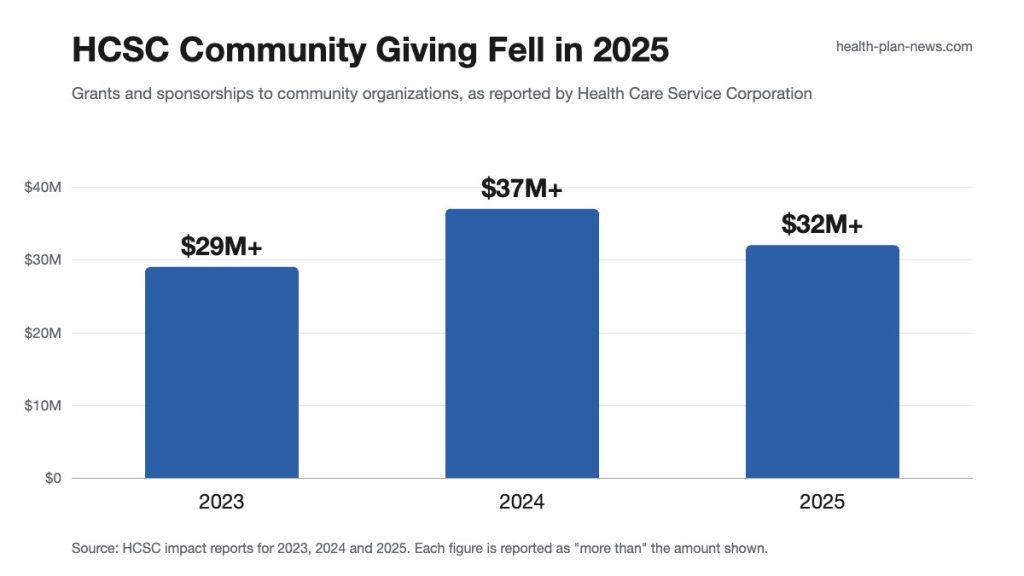
HCSC reported more than $37 million in grants and sponsorships for 2024. Its 2025 Impact Report puts the 2025 figure at more than $32 million. That was the year the company posted a net loss of more than $1.9 billion.
A foundation with its own assets can keep grants steady when the parent has a bad year, and the press release does promise more durable giving. HCSC has not said whether this foundation holds an endowment or draws on the company’s budget each year. That one detail decides how durable the giving really is.
What Does The Announcement Leave Out?
- The foundation’s starting budget or endowment
- Its legal and tax status
- Whether the state-level Blue Impact grants continue as they are or fold into the foundation
- How and when organizations can apply
- Which states outside the original five will see the first grants
There is also a business reason to notice. HealthSpring is an unfamiliar name in many of the markets HCSC entered through the Cigna deal, and local grants buy goodwill. We made a similar point about Fidelis Care’s maternal health grants: an insurer’s interest in a program does not make the money less useful to the clinic that receives it. Readers should still know the interest exists.
What Should Nonprofits, Employers And Members Do Next?
If your organization works in Illinois, Montana, New Mexico, Oklahoma or Texas, nothing in the announcement replaces Blue Impact, the state plans’ main grant program. Blue Cross and Blue Shield of Illinois alone sent more than $4.4 million to 121 nonprofits in the current cycle. Applications for that cycle closed on January 30, 2026, so check your state plan’s community giving page for the next window.
If you work outside those states, you are the audience the foundation says it wants to reach. Bookmark the foundation page. Prepare evidence that your program works, because HCSC says it intends to fund approaches with a track record and scale them.
Employers, brokers and plan members have nothing to act on. The foundation does not change coverage, networks or premiums. HCSC is owned by its policyholders, though, and that gives members a fair claim to ask how much is going into the foundation and where it lands.
The first grant list will answer most of these questions. Until HCSC publishes one, this is a new name on a giving program, and the dollars are still to come.