
Fidelis Care has awarded $140,000 in maternal health grants to eight healthcare providers and community organizations across New York, the Centene Corporation health plan announced on November 18. The money targets two measurable gaps: mothers who miss the postpartum checkup, and mothers who are never screened for depression.
Put the figure in proportion. Eight awards from a $140,000 pool works out to an average of $17,500 each. The application page capped awards at $20,000, and Fidelis Care did not disclose the individual amounts. That is seed money for outreach, doula support and screening. It will not close a statewide gap, and it is a modest sum for a plan that reports more than 2 million members.
For New York providers and nonprofits, the practical lesson is timing. This year’s application window opened September 8 and closed September 21, less than two weeks later. Any organization that wants a 2027 award should have a program outline and a budget drafted before the next call goes out.
Who Received the 2026 Fidelis Care Grants?
Fidelis Care named eight recipients under its Here for Your Health campaign:
- My Bump My Baby My World Foundation, New York City
- Sullivan County Department of Public Health, Sullivan County
- Baby Essentials of Long Island, Nassau and Suffolk counties
- Elizabethtown Community Hospital, Essex County
- Madison County Rural Health Council, Madison County
- Harmony Healthcare Long Island, Nassau County
- Champlain Valley Physicians Hospital, North Country
- Cocoon Wellness and Birth Center, Tioga County
The list leans rural. Five of the eight serve upstate areas outside the state’s major metro regions: Sullivan, Essex, Madison and Tioga counties, plus the North Country.
What Will the Money Pay For?
The release describes two of the eight projects in detail.
Madison County Rural Health Council, a nonprofit serving rural communities in central New York, will use its grant to improve postpartum visit attendance, increase maternal mental health screenings, and connect new mothers with doula support. Executive Director Christine Paul said the funding allows the council to strengthen its doula services and reduce barriers to care.
Baby Essentials of Long Island delivers diapers, formula and baby supplies directly to high-need families in Nassau and Suffolk counties. Its grant funds a program called BELI Healthy Starts: Postpartum Connect, which turns each delivery into a health check-in. Founder Kerry Gillick-Goldberg described the plan this way:
“For years, our deliveries have been a trusted touchpoint with families who are often hard to reach after the baby arrives. Through the grant-funded BELI Healthy Starts: Postpartum Connect program, every mother we visit will be screened for postpartum depression, reminded of her postpartum checkup, and connected to the support she needs.”
That model deserves attention. A mother who skips the clinic still opens the door for diapers.
How Big Is the Postpartum Care Gap?
Big enough that a health plan has a business reason to care. Postpartum visits and depression screening are both tracked in HEDIS (Healthcare Effectiveness Data and Information Set), the scorecard used to grade health plan quality. Every mother who keeps a visit improves the plan’s own numbers. That interest does not make the grants less useful, but readers should know it exists.
The numbers show how much room there is to improve:
- Average postpartum visit attendance in the U.S. is about 72%, according to Fidelis Care’s September call for applications, and missed visits reach 43% among patients of Federally Qualified Health Centers.
- In New York, 80% of Black mothers and 78% of Hispanic mothers received a postpartum checkup in 2020, compared with 91% of white mothers, according to a state report summarized by Behavioral Health News.
- Nationally, Medicaid plans documented a postpartum depression screening for only 8.7% of deliveries in 2023, and commercial plans for 4.4%, according to a Policy Center for Maternal Mental Health analysis of health plan quality data.
The screening figure is the one that should stop readers. Fewer than one in ten.
The setting matters too. Fidelis Care’s parent, Centene, operates Medicaid plans in many states, and private plans like these now cover 78% of Medicaid enrollees nationwide. When a managed care plan funds community screening, it is paying outside groups to reach members its own provider network has missed.
How Does 2026 Compare With Earlier Rounds?
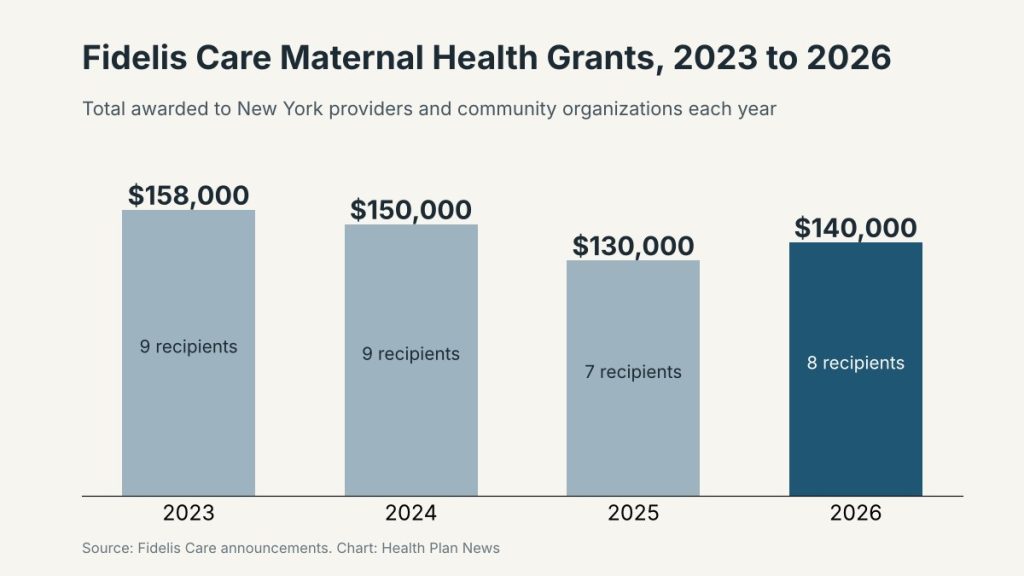
This is the fourth round of the program, and the totals have moved around:
- 2023: $158,000 to nine organizations
- 2024: $150,000 to nine organizations
- 2025: $130,000 to seven organizations
- 2026: $140,000 to eight organizations
Funding is up $10,000 from last year and still below the first two rounds. The earlier totals come from Fidelis Care’s own announcements.
Two smaller details stand out. First, the announcement ran late. In September, Fidelis Care said it would name recipients in October, during National Depression and Mental Health Screening Month. The list arrived November 18.
Second, the plan’s stated size has changed. Fidelis Care described itself as having more than 2.4 million members as recently as May. The new release says more than 2 million. Fidelis Care did not explain the difference, and this release is not the place it would. For context, national Medicaid enrollment fell 7% between July 2025 and July 2026.
What Should Providers and Members Do Next?
Community organizations and providers in New York should watch the Fidelis Care grant page rather than the calendar. The 2025 call for applications came in June with a July 8 deadline. The 2026 call came in September. Applicants who already know their baseline postpartum visit rate, their screening tool and the number of mothers they can reach will write a stronger proposal in a short window.
Fidelis Care members who are pregnant or recently gave birth have two steps available now. Keep the postpartum visit, and ask to be screened for depression at that appointment. Fidelis Care also lists BabyCare and Pomelo Care, a free virtual pregnancy and infant care service, among its programs for eligible members.
The real test arrives in a year. Fidelis Care reported that its first round of grants reached 1,320 expectant and new mothers and their babies. The 2026 recipients should be measured the same way: how many more mothers kept a postpartum visit, and how many were screened.