
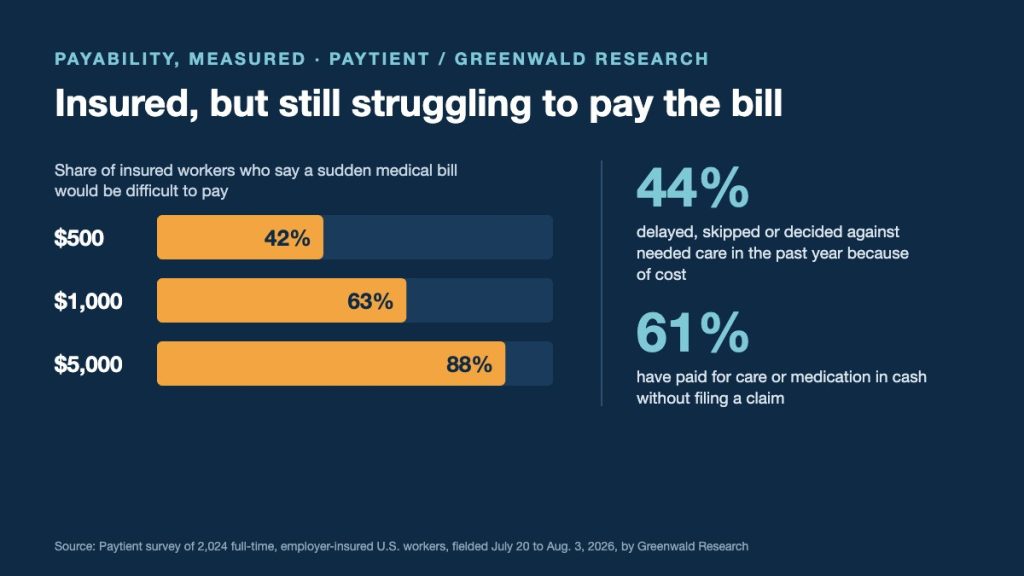
Sixty-one percent of workers with employer health insurance say they have paid for care or medication entirely in cash, without filing a claim, according to a new survey of 2,024 full-time employees conducted by Greenwald Research for Paytient. The same study found that 44% delayed, skipped or decided against needed care in the past year because of cost.
Those numbers describe a gap that most benefits reports never show: people who are covered, paying premiums, and still going around the plan or going without. Read the source with care. Paytient sells a payroll-based way for employees to pay medical bills over time, and the paper, Payability, Measured, makes the case for exactly that product. The survey data is useful. Some of the conclusions drawn from it go further than the data does.
For employers and brokers heading into 2027 renewals, the practical takeaway is simple. Before adding a payment-plan vendor, find out how many of your own employees are deferring care, and why. Health Plan News reads the 44% deferral figure as the finding that matters most here, and the one an employer can test against its own claims data.
What the Paytient Survey Found
Greenwald Research fielded the online survey between July 20 and August 3, 2026. Respondents were 18 or older, worked full time and had health insurance through an employer. The results were weighted by income, age, gender, race and ethnicity, education and employer size, and the stated margin of error is plus or minus 2 points at the 95% confidence level.
The headline findings from the paper:
- 61% have paid for care or medication in cash at some point without filing a claim.
- 44% delayed, skipped or decided against needed care in the past year because of cost.
- Only 22% say they can comfortably handle most out-of-pocket costs.
- 42% call a sudden $500 bill difficult to pay, 63% say the same at $1,000, and 88% at $5,000.
- 68% would rather pay a major medical bill through smaller paycheck deductions than in a lump sum.
- Only 29% believe their employer fully grasps what paying for care out of pocket is like.
The deferral rate tracks each worker’s pain point. Among employees who would struggle with a $500 bill, 68% held back on care. Among those who would struggle only at $5,000, the figure fell to 20%. Among employees who could handle every amount tested, it was 13%.
Why This Matters For Employers and Plan Members
Employer health insurance coverage is getting more expensive at a pace few budgets absorb easily. A Mercer survey of more than 1,800 employers projects an 8.2% rise in health benefit cost per employee for 2027 after planned changes, and about 11% if employers did nothing. The usual response is to raise deductibles, which moves the bill to the employee.
That is where the Paytient data bites. A higher deductible saves the plan money only if the deferred care does not come back later as a bigger claim. The paper argues that it does come back, at higher acuity and higher cost. That claim is plausible. But the survey measures behavior, not claims. It cannot show the downstream cost.
The Deductible Reset Problem
Eighty-four percent of respondents know their deductible resets on January 1, and 72% say the reset affects their care decisions. For a plan sponsor, that means the first quarter of every plan year carries a predictable wave of put-off appointments.
The reset will be steeper for some members in 2027. The IRS set the minimum deductible for an HSA-qualified high-deductible plan at $1,750 for self-only coverage, as covered in our report on the 2027 FSA and HSA limits. Per the survey, a bill that size is hard for well over half of insured workers.
The $1,000 Versus $2,000 Question
The most quoted finding is that 67% of workers say a $1,000 bill due tomorrow would be harder to manage than a $2,000 bill with six months to pay. The press release describes this as a preference to pay more over time.
That is a stretch. The paper asked which bill would be harder to manage, not which one people would choose. The answer says a great deal about cash on hand. It says less about whether employees want to pay double. Nobody is offering that trade, and no employer should design a plan as though workers asked for it.
What the Cash-Pay Figure Does and Does Not Show
The 61% figure deserves the closest reading. The paper says a benefit went unused “because the employee couldn’t manage the payment at that moment.” Its own data points elsewhere.
Asked why they paid cash, 45% cited a provider their insurance did not cover and 37% cited a lower cash price. Another 30% cited convenience. Only 27% said they had not met their deductible. Most of these are network and pricing problems, not timing problems. A worker who pays cash for a generic prescription because the cash price beats the copay is making a sensible choice. That worker did not fall through a gap.
The question also asked whether respondents had ever paid cash without a claim. That bar is low, and it makes 61% less dramatic than the release suggests.
The study’s strongest finding is the plainest one. Insured workers put off care when the bill arrives faster than the paycheck, and they say so across income levels. Seventy percent of workers earning under $50,000 prefer paycheck installments, compared with 72% of those earning $50,000 to $99,000 and 67% of those above $100,000. Lisa Weber, Chief Research Officer at Greenwald Research, said the result “isn’t a low-income affordability story.”
“Using payroll to smooth out-of-pocket costs is the plan design opportunity hiding in plain sight, and it can help employers save substantially on plan costs,” said Joe Gabler, Chief Operating Officer of Paytient.
Health Plan News sees merit in that idea, with a caveat. Smoothing payments solves a cash-flow problem. It does not lower what care costs, and pairing a higher deductible with an installment plan still moves more of the bill to the employee. It just spreads it out.
What To Do Next
Employers and brokers weighing a payroll-based payment benefit should ask a few direct questions before signing:
- What fees or interest, if any, do employees pay on an installment balance?
- What happens to an unpaid balance when an employee leaves the company?
- Does the vendor report balances to credit bureaus or send them to collections?
- How does the program work alongside an HSA or FSA the employee already funds?
- What claims data, not survey data, supports the promised savings?
Employees have options right now, too. Ask for the cash price before a scheduled service, and ask the hospital or clinic for an interest-free payment plan before reaching for a credit card. Hospitals can also ask for money up front, as our guide on why you may still need to pay a hospital deposit explains.
The survey’s most useful lesson for plan sponsors is that only 29% of workers think their employer gets it. That is cheap to fix. Ask employees how they pay for care, and match the answers against your own claims data before buying the next fix.
Payability, Measured is the second of four papers in Paytient’s series. The full report requires a form submission on Paytient’s site.